
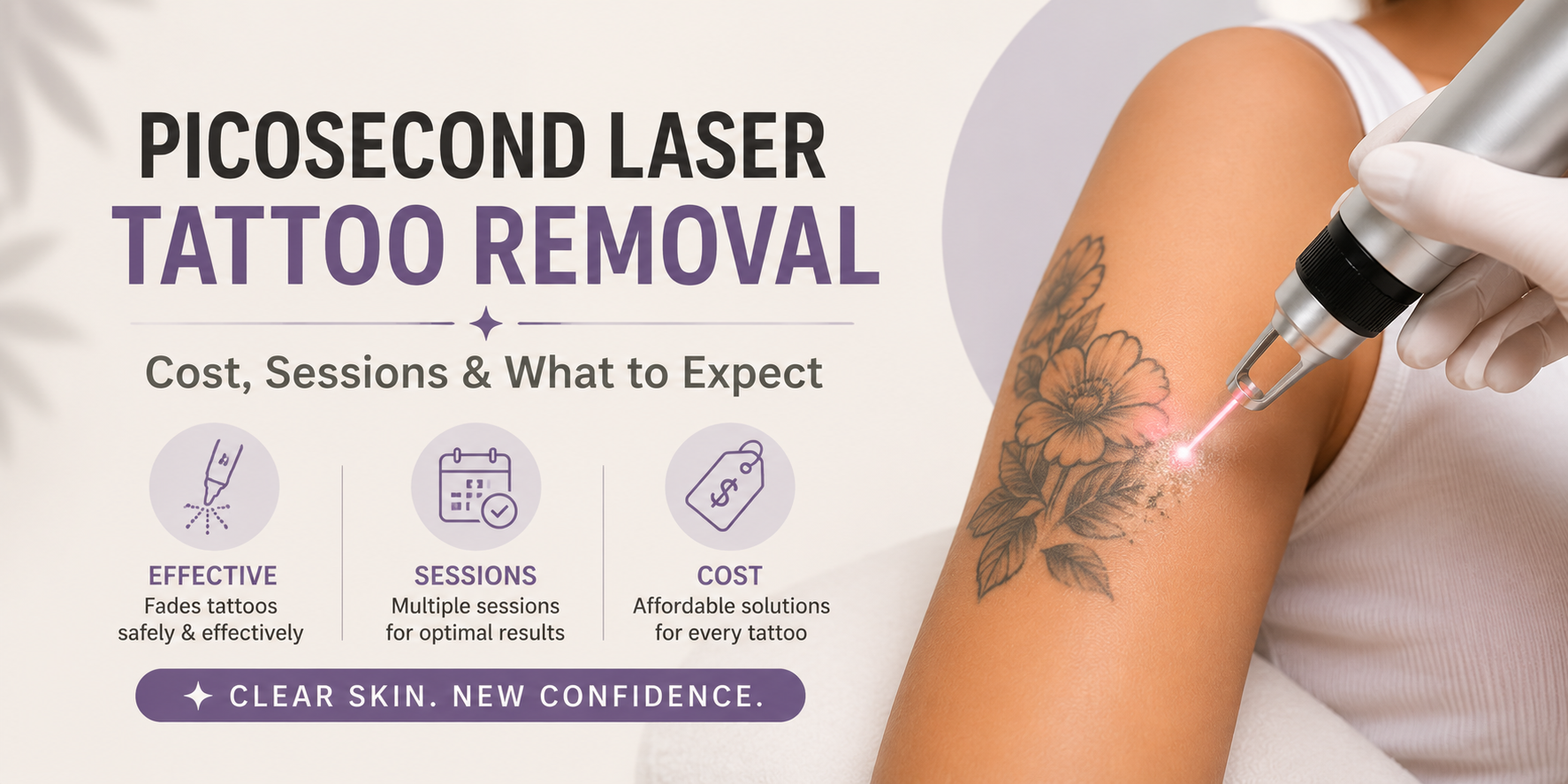
 A picosecond laser breaks tattoo ink into particles small enough for the body to clear on its own, which is why it typically needs fewer sessions than older Q-switched lasers, especially for stubborn colours like green and blue. The trade-off is a higher upfront investment in the equipment, so the cost question runs in both directions: what a client pays per session, and what a salon pays to offer the treatment at all.
Short Answer
A single session of picosecond laser tattoo removal typically costs between 50 and 250 EUR, depending on the size of the tattoo, ink density and the studio's location. Full removal usually takes 4 to 10 sessions spaced 6 to 8 weeks apart. Multi-colour and professionally inked tattoos sit at the higher end of both the price and session count.
How Picosecond Lasers Remove Tattoo Ink
The laser fires ultra-short pulses, measured in picoseconds, at the pigment in the skin. Because the pulse is so short, it shatters the ink into much finer particles than older nanosecond lasers, and the immune system carries these smaller fragments away over the following weeks. The surrounding skin absorbs very little of the energy, which is why the treatment carries a low risk of scarring when performed correctly.
Different wavelengths target different ink colours, so a device that only offers one wavelength limits which tattoos a studio can treat.
| Wavelength | Best for |
|---|---|
| 1064 nm | Black and dark blue ink, and deeper pigment such as birthmarks and age spots. |
| 532 nm | Red, orange and brown ink, as well as freckles and superficial pigmentation. |
How Many Sessions Does It Take?
There is no single number that applies to every tattoo. As a rough guide:
- Small, single-colour tattoos often clear in 4 to 6 sessions.
- Larger or multi-colour tattoos commonly need 6 to 10 sessions or more.
- Professionally applied tattoos with dense, saturated ink generally take longer than amateur or stick-and-poke tattoos.
Sessions are spaced 6 to 8 weeks apart to give the body time to clear the broken-down ink and let any inflammation settle before the next pass. Booking sessions closer together does not speed up the process and increases the risk of skin damage.
What Determines the Price
Per-session pricing for clients is usually built around:
- Size of the tattoo – priced per square centimetre or by size bracket (small, medium, large).
- Ink density and number of colours – multi-colour tattoos need more passes and sometimes more than one wavelength.
- Number of sessions required – some studios offer package pricing for a full course of treatment rather than charging per visit.
- Location and local market rates – prices vary significantly between cities and countries.
Does It Hurt, and What Does Aftercare Look Like?
Most clients describe the sensation as a series of quick, hot snaps against the skin, often compared to a rubber band flicked repeatedly. Numbing cream can reduce discomfort for larger areas. Immediately after treatment it is normal to see redness, mild swelling and sometimes small blisters or pinpoint bleeding; the area should be kept clean, protected from the sun and left to heal without picking at any scabbing.
Opening a Tattoo Removal Service in Your Salon
For a studio, the real cost question is the device itself rather than a single session. A professional picosecond laser is a multi-thousand-euro investment, so it is worth factoring in training, warranty and after-sales service alongside the machine price before deciding to offer the treatment. Once the equipment is in place, tattoo removal can run as its own service line or alongside existing laser treatments such as hair removal.
Picosecond Laser for Your Studio
Professional Nd:YAG picosecond laser with 1064 nm and 532 nm wavelengths for tattoo, pigment and eyebrow-tattoo removal. Technical specifications, included training and price are on the product page.
SEE THE PICOSECOND LASERFrequently Asked Questions
How much does picosecond laser tattoo removal cost?
A single session typically costs between 50 and 250 EUR depending on the tattoo's size, ink density and the studio's location. Clients should budget for the full course of sessions, not just one visit, since most tattoos are not fully removed after a single treatment.
How many sessions of picosecond laser are needed to remove a tattoo?
Most tattoos need 4 to 10 sessions spaced 6 to 8 weeks apart. Small, single-colour tattoos tend to clear faster, while large, multi-colour or densely inked tattoos need more sessions.
Does picosecond laser tattoo removal hurt?
It causes a brief, hot, snapping sensation with each pulse. Most clients tolerate it without numbing cream, though it can be used for larger areas or more sensitive skin.
Is a picosecond laser better than a traditional Q-switched laser?
For most ink colours, yes – the shorter pulse breaks ink into finer particles, which generally means fewer sessions and less risk to the surrounding skin. Q-switched lasers can still be effective, particularly on a budget, but usually take longer to reach the same result.
How long should you wait between tattoo removal sessions?
6 to 8 weeks is standard. This gives the body time to clear the broken-down ink and lets the skin fully recover before the next treatment.
This article is for general information only and does not replace a professional consultation. Anyone considering tattoo removal should discuss their specific tattoo and skin type with a qualified practitioner first.